Media & Public Communication
Beyond academic research, I also enjoy writing for general audiences. My public-facing work focuses on translating scientific and policy research into accessible essays and blog posts that highlight their relevance to everyday life and real-world decision-making. These writings explore how emerging technologies, scientific advancements, and systems-level changes influence people’s health, well-being, and lived experiences.
I see science communication as a critical bridge between research, practice, and civic engagement. I am a regular contributor to the World Economic Forum Agenda Blog and GlobalDev Blog, where I share perspectives on global health challenges, scientific innovation, and the societal implications of health policy.
2020 – Present
Years of Public Writing
5 +
Languages Translated Into

-

Health & Social Capital
Revisiting solidarity to build healthcare systems from the bottom up
Zili
Jul 30, 2025
GlobalDev Blog
- The article argues that beyond infrastructure and finance, shared mutual support and social capital — often overlooked in policy — are vital for resilient healthcare systems.
- It reflects on how social institutions shaped during economic development can serve as a basis for locally empowered, community-driven healthcare delivery models.
- The piece builds on a short course assignment in DEV 308 Social Institutions and Economic Development taught by Dr. Michael Woolcock at Harvard Kennedy School.
🌐 Also available in:
-

Risk Communication
Overcoming Stigma – A New Narrative for Fukushima on Its 15th Anniversary
Zili & colleagues
Mar 21, 2025
Health and Global Policy Institute
- This presentation was part of a webinar organized following a Harvard field course in Fukushima, Japan, where we studied the long-term social and health impacts of the 2011 earthquake and nuclear accident.
- As part of the Risk Communication Group, we explored how persistent stigma continues to shape public perceptions of Fukushima, which often overshadows the region’s recovery efforts.
- Drawing on field interviews and local engagement, our group proposed strategies to reframe the narrative surrounding Fukushima as the disaster approaches its 15th anniversary.
Learn more:
-

Health Sciences
Not just a number: Science is redefining how we understand ageing
Zili & Kejun
Nov 1, 2024
World Economic Forum
- Ageing research is advancing quickly; we can now measure the “true” health of bodily organs like the heart and brain.
- Today, each of our organs has its own clock through which we can see its age and thus health.
- Turning that development into actionable healthcare is a key next step
🌐 Also available in:
-

Transport & Mobility
How China is strengthening its electric vehicle market during the pandemic
Peng & Zili
May 28, 2020
World Economic Forum
- COVID-19 placed significant burdens on small- and medium-sized enterprises, some of the most vulnerable groups in China during this crisis.
- China’s automotive market is forecast to decline 15.5% this year and the government is applying stimulus.
- China has remained committed to the transition to electrification, part of a long-term strategy.
- Other industry players should try to leverage this period to accelerate their transition to electrification as well.
🌐 Also available in: Chinese
-

Transport & Mobility
How Chinese companies are responding to COVID-19 mobility challenges
Peng & Zili
Mar 03, 2020
World Economic Forum
- COVID-19 has affected mobility in China, with transport down 50% around Chinese New Year, compared to last year.
- Many people are staying home, increasing demand for services such as online deliveries.
- Here’s how some companies have responded, including new services to help hospitals and the use of autonomous vehicles for deliveries.
🌐 Also available in: Spanish
-
Transport & Mobility
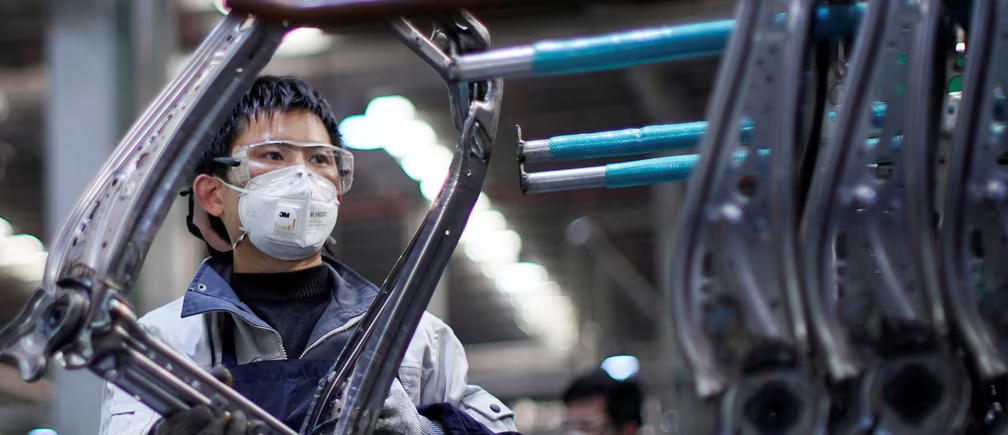
This industry was crippled by the coronavirus – here’s how it’s fighting back
Peng & Zili
Feb 25, 2020
World Economic Forum
- Coronavirus, which began in Wuhan, China, has shut down factories.
- Car sales in China fell 92% in the first half of February.
- The impacts are being felt around the world, as shortages affect production.
🌐 Also available in: Japanese
-

Health Sciences
一文掌握新型冠状病毒疫情来龙去脉
Wen & Zili
Feb 18, 2020
World Economic Forum
- Where did COVID-19 really come from? This article walks through what we know so far — including how scientists are tracing the virus’s origins using genetic evidence and environmental sampling.
- Transparent and science-based collaboration is key to understanding and responding to global health crises.
-

Transport & Mobility
新冠病毒对交通和汽车行业的影响
Peng & Zili
Feb 17, 2020
World Economic Forum
- Passenger trips during the 2020 Spring Festival dropped by nearly 50%, disrupting mobility across China.
- Factory shutdowns in Wuhan triggered ripple effects globally — from Hyundai to Tesla.
- Automakers launched mask production lines, and JD.com deployed autonomous vehicles for contactless hospital deliveries.